- With this new facility, the centre will reduce direct CO₂ emissions by up to 95 per cent and cement its position as a benchmark in Europe by combining its production capacity with a more efficient and sustainable model
- This project, which combines competitiveness, technology and innovation, has received funding under the first round of grants awarded by the Ministry of Industry and Tourism as part of the PERTE for industrial decarbonisation
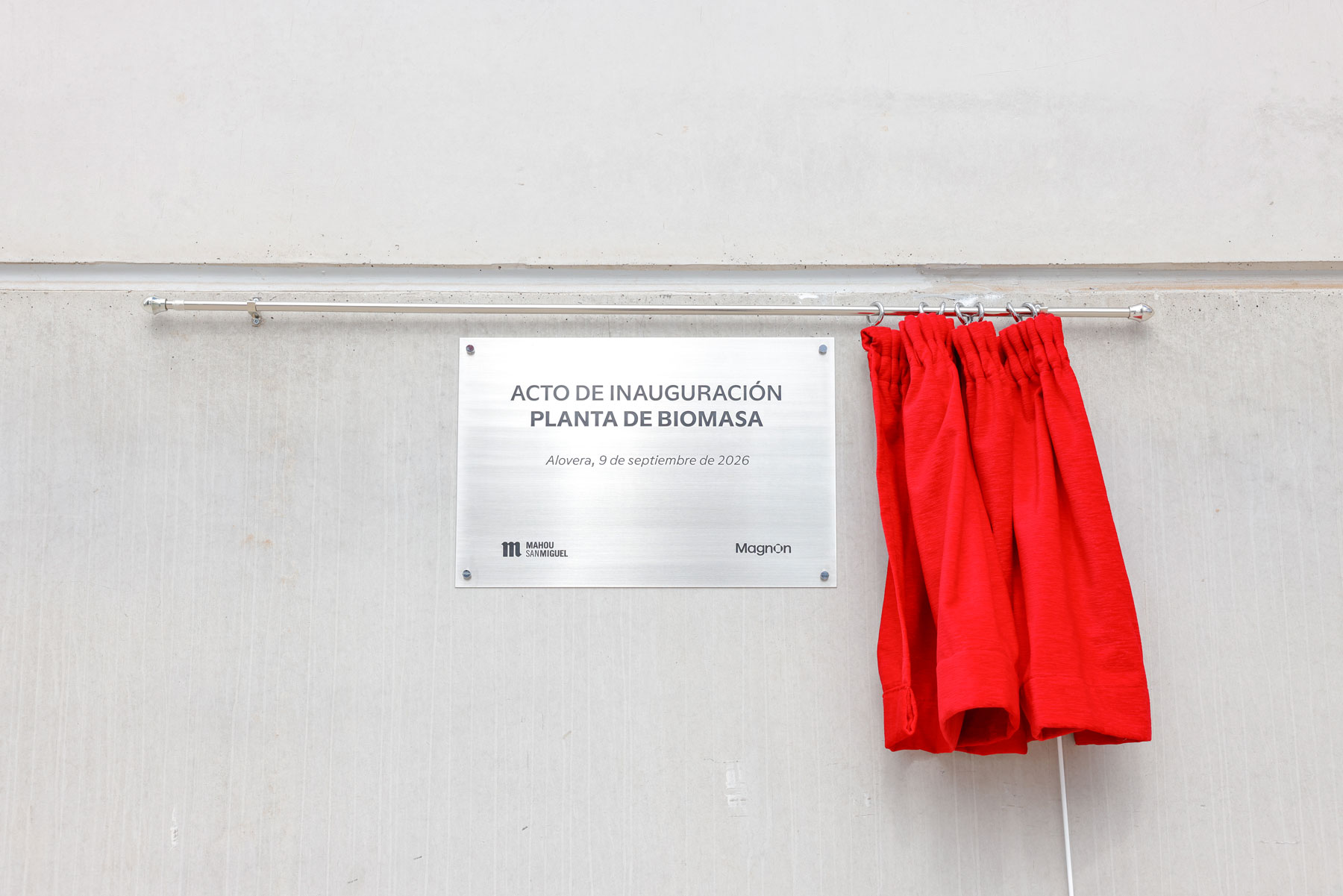
Mahou San Miguel, a 100 per cent Spanish family-owned drinks company and the leader in the country’s beer sector, this morning inaugurated a biomass plant at its factory in Alovera (Guadalajara) that will enable it to reduce the production centre’s direct CO₂ emissions by up to 95 per cent, thanks to the gradual replacement of natural gas with renewable thermal energy from biomass.
The project has been designed, built and operated by Magnon, Ence’s renewable energy subsidiary and Spain’s leading agroforestry biomass management company, and has received funding under the first round of grants awarded by the Ministry of Industry and Tourism as part of the PERTE programme for industrial decarbonisation.
The biomass plant at the Alovera brewery – the largest in the Spanish brewing sector – reinforces the role of Mahou San Miguel and Magnon, Ence’s renewable energy subsidiary, as drivers of an increasingly efficient, competitive and sustainable industry.
It also marks a milestone in Mahou San Miguel’s progress towards the decarbonisation targets set out in its ‘Compartimos Futuro’ sustainability roadmap, which aims to achieve carbon neutrality across its entire value chain by 2050. For its part, with this initiative, Magnon reaffirms its position as a leader in industrial decarbonisation thanks to its expertise in the design, implementation, operation and maintenance of renewable industrial heat projects such as the one it has carried out for Mahou San Miguel.
The opening ceremony was attended by representatives from various institutions, partners and senior executives from Mahou San Miguel and Ence. Among other prominent figures were Emiliano García-Page, President of the Regional Government of Castile-La Mancha; Jordi Hereu, Minister for Industry and Tourism; and Maria Purificación Tortuero, Mayor of Alovera, who took the opportunity to highlight the role of public-private partnership in accelerating the decarbonisation of Spanish industry.
“At Mahou San Miguel, we believe that leading a sector also means driving its transformation. As the brewing company with the largest industrial footprint in Spain, we have a responsibility to continue promoting a growth model that combines competitiveness, innovation and sustainability,” said Alberto Rodríguez-Toquero, managing director of Mahou San Miguel. “The opening of this plant embodies this approach to our business and reinforces the role of the Alovera factory as a benchmark for the sector at European level, not least because of the value it generates for the local community and society,” he added.
“At Magnon, Ence’s renewable energy subsidiary, we are firmly committed to developing comprehensive solutions for a decarbonised industry. The commissioning of this plant in Alovera confirms the potential of biomass to decarbonise industrial processes that are difficult to electrify,” said Lidia Roca, managing director of Magnon Servicios Energéticos. “By using a renewable, locally sourced resource, we are helping our customers reduce their emissions and dependence on fossil fuels, whilst also helping to strengthen Spain’s strategic autonomy,” she added.
17,000 tonnes less CO₂ per year
With the plant now operational, the Alovera factory is reducing its reliance on natural gas, improving its energy efficiency and strengthening the resilience of its operations. Thanks to the installation of two biomass boilers with a combined capacity of 20 MWt, it will produce over 85,000 MWh of thermal energy per year and prevent the emission of around 17,000 tonnes of CO₂ annually.
The plant will use approximately 30,000 tonnes per year of forestry and agricultural biomass certified under the SURE scheme, supplemented by the use of biogas generated at the site’s own wastewater treatment plant. As next steps, the company is exploring the use of bagasse from the beer-brewing process as an energy source.