- Pulp prices shaped the year’s results. Financial year 2025 was marked by a decline in celulosa prices, which fell to an average of $1,086/t. The outlook for 2026 is favourable. Prices have already reached $1,250/t, with leading producers announcing increases to $1,330/t.
- Cash cost down. Cash cost closed 2025 at its lowest level since 2022, standing at €483/t. The company currently has additional measures underway to reduce it by a further €30/t.
- Collective redundancy procedures. The company has reached agreements with workers’ legal representatives and will implement a 15% reduction in its total pulp workforce.
- Ence continues to develop the largest diversified renewable energy platform based on biomass in the Iberian Peninsula, transforming this raw material into regulated electricity, renewable industrial heat, biomethane and renewable fuels.
Ence is moving forward decisively in its transformation into a specialty pulp producer competing with higher-cost long fibre. At year-end 2025, this product category accounted for 30% of Pulp sales, seven percentage points more than in 2024, with an additional margin of €37/t compared to standard fibre. The company’s target is for this figure to exceed 62% of sales by 2028.
A key milestone in this strategy was the start-up, in the fourth quarter of 2025, of the first fluff pulp line at the Navia biofactory, with an annual capacity of 125,000 tonnes. Ence thus becomes the only European producer of eucalyptus-based fluff pulp, competing in the local market with higher-cost long-fibre producers.
This new product, currently undergoing customer qualification processes, targets the European absorbent hygiene products market and enables the substitution of imports, offering a more cost-competitive alternative to the long fibre it replaces.
Commitment to cost reduction
The company remains focused on cost reduction. The measures being implemented have begun to bear fruit, and the 2025 cash cost was the lowest since 2022. It closed at €483/t, representing savings of €70/t compared to 2022 and €10/t compared to 2024.
Additionally, two initiatives are underway to reduce production costs by €30/t between 2026 and 2027. The first is the Efficiency and Competitiveness Plan for the Pulp business, aimed at delivering €22/t of the projected €30/t savings. The second is the cost reduction and decarbonisation plan at the Navia biofactory, designed to generate additional savings of €8/t.
Progress in the renewable energy platform
With regard to the renewable energy platform, in 2025 biomass electricity generation reached annual output of more than 1,240 GWh, 6% higher than in 2024. Fourth-quarter generation amounted to 346 GWh (+10% vs. Q4 2024).
Meanwhile, the industrial heat business, focused on decarbonisation projects for industry, signed three contracts in 2025. A fourth initiative is currently in the start-up phase.
In the biofertilisers and biomethane business, the company continues to develop its portfolio, with 25 projects at an advanced stage of engineering and administrative processing.
Financial results
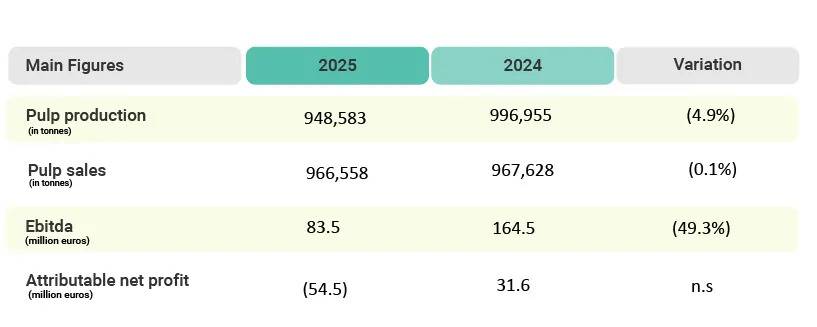
At year-end 2025, pulp production stood at approximately 950,000 tonnes. Pulp sales increased by 4% in the fourth quarter, reaching nearly 245,000 tonnes.
The company closed financial year 2025 with losses of €55 million, a figure that includes a €24 million provision related to the impact of the collective redundancy procedures under the Efficiency and Competitiveness Plan.
Notably, EBITDA from biomass electricity generation in the second half of 2025 amounted to €20 million, implying an annualised EBITDA of €40 million.
Net financial debt at year-end totalled €378 million, compared with €321 million in December 2024.